Professional industrial inkjet printer manufactuers.
Language
Professional industrial inkjet printer manufactuers.
An online inkjet printer for packaging bags works in an environment that is different from printing on a rigid carton or metal part.
The printer may be capable of producing the required date, batch number or QR code, but the packaging bag itself can move.
It can wrinkle.
It can bend.
It can shift sideways.
After filling, the same bag can also change from a flat printing surface into a curved or uneven package.
For flexible packaging, we pay close attention to where the printing happens.
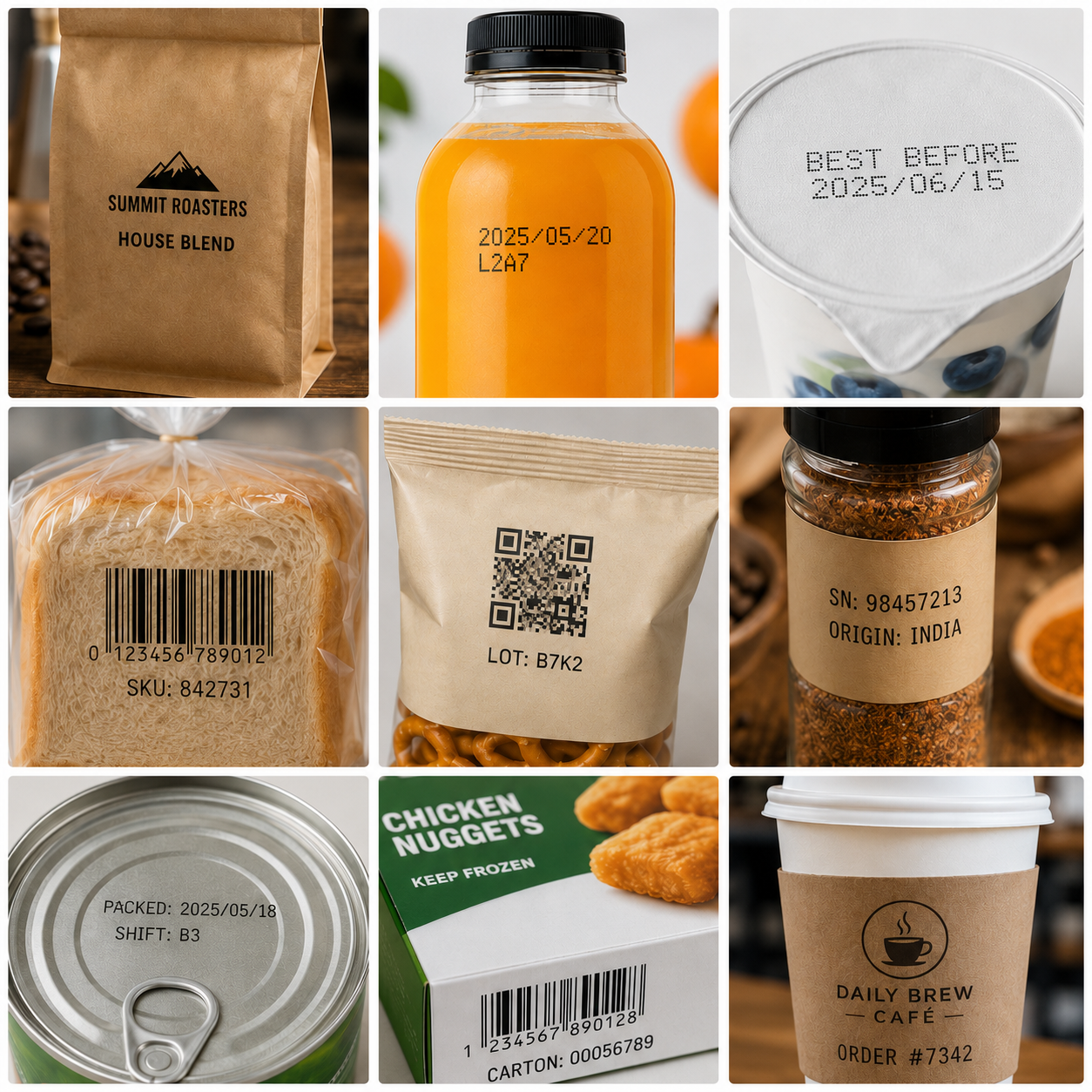
Empty Bag and Filled Bag Are Not the Same Printing Surface
A flat empty bag can provide a relatively stable surface.
After filling, the product inside may push part of the bag outward and change the distance from the printhead.
This is one reason the printing position should be considered together with the packaging process.
In some lines, the best position is while the film or bag is still controlled and flat.
In others, the machine layout means the code has to be applied after filling or sealing.
There is no universal answer.
For an inkjet printer for flexible packaging, we want to find the point where the package is stable enough for repeatable printing and where there is enough installation space for the printhead.
A faster printer cannot compensate for a bag that repeatedly moves away from the print position.
The physical product path comes first.
Packaging Bags Can Use Very Different Materials
A packaging bag is not one material category.
It may be paper, plastic film, laminated material or a pre-printed pouch with its own surface treatment.
That changes ink behavior.
On paper-based packaging, absorption may be the main factor.
On smooth flexible packaging, ink adhesion and drying can become more important.
Pre-printed bags introduce another issue: contrast.
A black code placed over a dark graphic may technically print correctly but still be difficult for the customer to read.
For this reason, we like to see the actual coding area.
The bag color, background design and surface finish are part of the printing application.
Online Date Coding Is Usually Simple Until the Message Grows
Many customers start with a basic requirement:
production date
expiry date
batch number
An online date coding printer can handle this type of variable information without requiring a separate manual stamping process.
But production requirements often grow.
Later, the customer may want a serial number, barcode or QR code.
The larger or more detailed the message becomes, the more important product stability becomes.
A date code can tolerate a small amount of position movement when there is plenty of blank space.
A QR code placed inside a narrow design area cannot.
If machine-readable information is required, we test whether the finished code can actually be read on the final package.
A flat sample may not be enough if the bag changes shape after filling.
Triggering the Print Is Only Part of Product Control
A sensor can detect the passing bag and trigger the printing process.
That does not automatically make the bag stable.
If the product moves sideways after detection, the code will still shift.
Guides, conveyor setup or a better printing position may be needed.
If line speed changes significantly, the printing system may also need speed information so the message maintains the correct length.
For an online inkjet printer for packaging bags, we therefore look at both the trigger signal and the physical package movement.
These are two different issues.
A reliable sensor cannot compensate for unstable bag guidance.
We Prefer the Real Bag and a Short Line Video
For flexible packaging projects, two things tell us a lot:
the real bag and the actual production line.
The sample helps us evaluate the surface, ink and code.
The video helps us see how the bag moves, where the printhead could be installed and whether the product is flat at that point.
This is especially useful if the customer is adding the printer to an existing packaging machine.
The correct machine depends on what the factory actually needs to print and how stable the package is during that process.
For an online inkjet printer for packaging bags, that production information is more useful than selecting the printer only by maximum speed.
Professional industrial inkjet printer manufactuers.
Industrial Inkjet Printer